I received the WORST BAD REVIEW...and I love it

I'll explain why, what I've learned about myself and my writing, and why I feel motivated to write more.
Back in the late 2010s, I was writing erotica. I self-published a handful of books and did freelance work for private customers (an entirely different blog post that I may write). My output of erotica was a fantastic representation of my ADHD and autism at their most powerful.
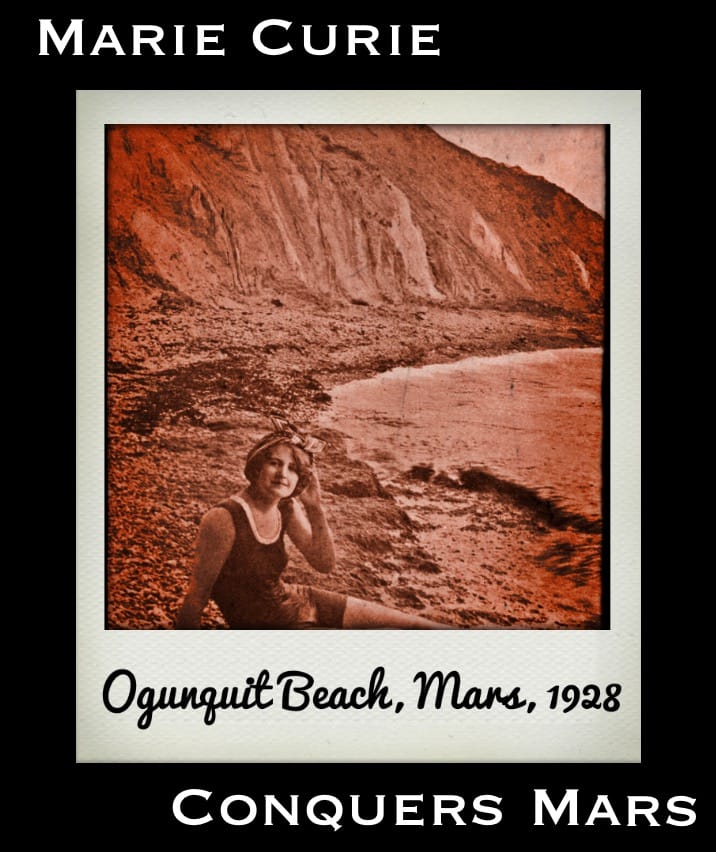
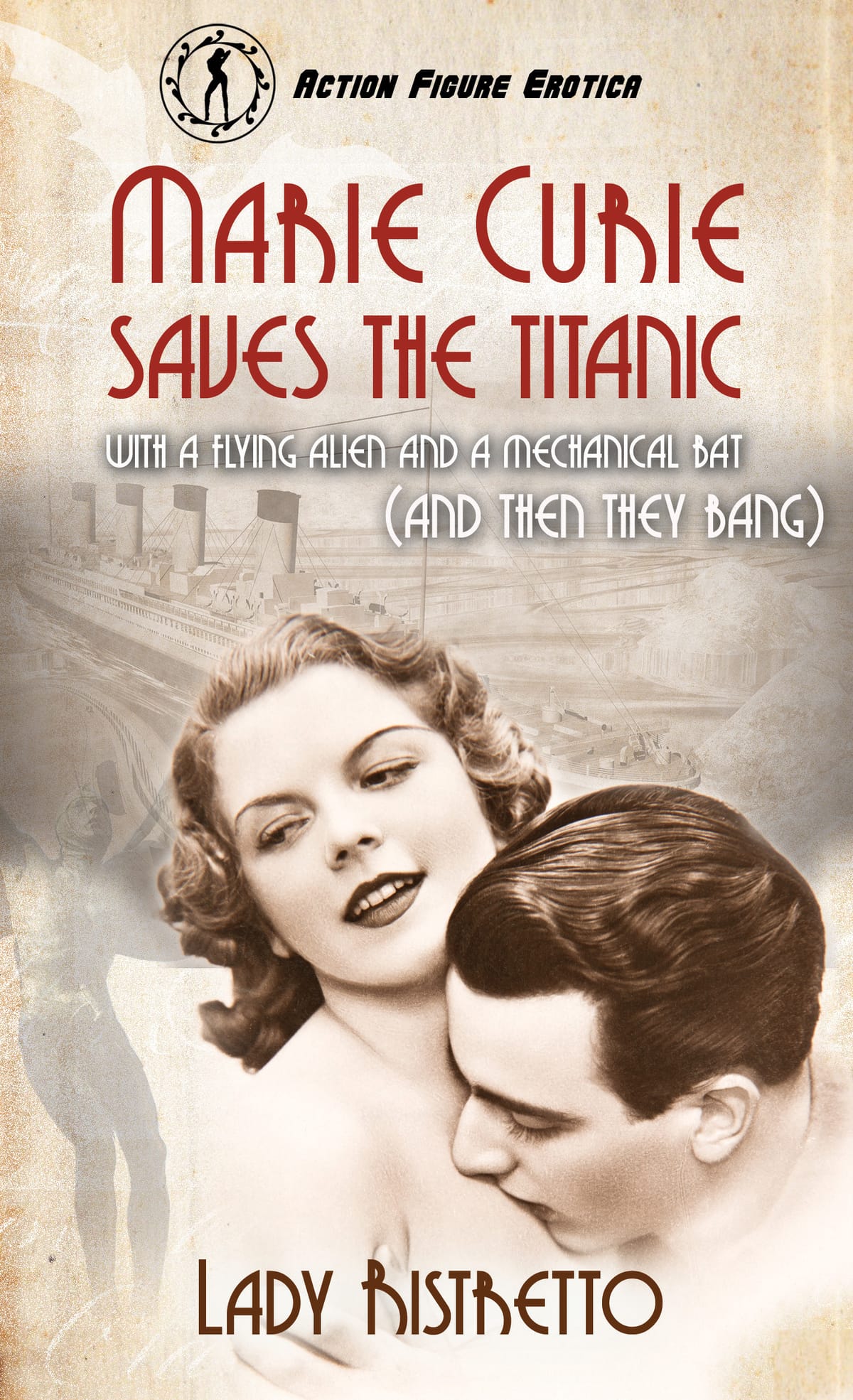
I published a novella called Marie Curie Saves the Titanic (MCST). I created a genre (to keep the erotica interesting for me) called Action Figure Erotica. It had one rule: the main characters had to have been made into an action figure at some point. It’s playful and absurd at times. My big inspiration was Robot Chicken, as well as playing with Barbie dolls with my Transformers.
There is a link below to download the book. TW: explicit sex scenes involving multiple sexual orientations.
MCST has Marie and Pierre Curie, Kent Calhoun and Brewster Wainwright (dollar store action figure versions of Superman and Batman respectively), Albert and Mileva Einstein, and Rudolph Valentino. All of it takes place in 1911 on the Titanic’s maiden voyage; spoiler alert: the Titanic doesn’t sink.
Marie Curie has absorbed so much radiation from her work with uranium that she glows green, emits tremendous heat, must wear lead-lined clothes, and can levitate objects and fly. Pierre Curie has these abilities as well.
The story does have some psychological realism. Marie is in an emotionally abusive marriage with Pierre and struggles with her sense of self and self esteem. Having sex-for-pleasure with multiple partners helps her feel control over her body and her own unique powers.
In 2017, I submitted the book to a publisher and it was accepted. A few weeks later, the publisher went out of business. I was pissed. I was so pissed, I left the book on my Google Drive and forgot about it. I stopped writing erotica maybe a year after and started painting instead.
A couple of weeks ago, I was hunting online looking for another action figure erotica novel I had started and forgot about: Medusa Gets Her Hair Done . In the midst of doing Google searches under Lady Ristretto, I found a one-star Goodreads review for MCST.
It is blistering.

And I love it.
I’m going to go through this review carefully. I reread MCST to refresh my memory. I’ll explain why I love this review, what it tells me about my work, how I failed, and why I feel inspired to do more action figure fiction (I’m not writing erotica anymore).
“I honestly can’t begin to understand what the hell was going on with this book, and I was beginning to feel like I was missing something.”
This opening made my heart swoon.
First of all, this reflects a failure on my part: I didn’t properly explain the genre of the book and what Michelle felt was “missing”. The worst thing a writer can do is alienate their audience unintentionally. Doing so intentionally is something different entirely.
This thrilled me because I realized that I’ve never truly understood what kind of author I am. When I wrote MCST, I assumed it was fairly formula in structure and the plot straightforward. The title unabashedly gives away the ending of the story: Marie Curie saves the Titanic from sinking. I believed the book is traditional.
It is not. With enormous glee, I realized that, at my core, I’m nontraditional. I thought I had created a standard erotic novel for a mainstream audience. Honestly, I would rather be entirely nontraditional than mainstream because mainstream bores me.
Michelle goes on in more detail:
"For instance, frequent references are made to the Titanic, but at the same time, Einstein, laptops and text messages are mentioned. I honestly cannot comprehend what the hell is going on in this book. It's like multiple, disjointed stories all going on at once.
I wrote a Chaos novel. I had no idea at the time. I hadn’t come up with the concept of a Chaos plot structure back then. It’s only the past couple of years that I’ve been formulating my nontraditional plot ideas.
This description is vitally important. What she describes is the universe of the story. Time and place are smashed together. None of these characters knew one another in “real life”, with the exception of Marie and Pierre Curie, nor were they on the Titanic when it sank. Technology is contemporary. The “superpowers” that four of the characters have are fantastical.


The narrator of the book would be considered restricted third person omniscient, but what I would also label as a Conflicted Narrator: one that violates the world we all agree exists and creates something contradictory and impossible. This type of narrator is a step beyond unreliable; the narrator is deliberately smashing the fourth wall and making multiple statements about reality and fantasy.
No mainstream erotica reader would expect nor understand (and probably not want) to have this kind of experience with a novel.
I incorrectly marketed this book and I feel awful that I wasn’t clearer and more forthcoming. It truly is erotica with Chaos, Asymptote, and Stimulus plot structures.
I explain Chaos and Asymptote structures in detail in my ebook, and give brief descriptions of all plot structures on the Nontraditional Plot Structures page in this blog.


Stimulus is a new structure that I categorize as a Force structure. This definition of Stimulus from Google AI:
A stimulus is an agent, action, or change that evokes a response. It can be something that excites or activates a physiological process or causes a behavioral change.
The events in a stimulus plot must be the focus and the point of the story. The story cannot occur unless someone performs specific, special, and significant stimuli. A Stimulus plot structure isolates, highlights, and develops in complex ways and different forms of stimulus.
Erotica has a Stimulus plot structure; the characters are in constant pursuit of sexual stimulus and satisfaction, whether or not they acknowledge this.
I learned how to write erotica from Anais Nin and Henry Miller, specifically from Nin’s Little Birds and Miller’s Under the Roofs of Paris (massive trigger warning: I’m actually surprised this book is still available as it violates obscenity laws and barely qualifies as anything of artistic merit).
Nin and Miller had an affair during the early 20th century. Their writing styles and erotica could not be more different. Nin wrote beautiful, feminist stories; Miller wrote five alarm fuck fests. In their works, sex is the primary focus. There is no significant character work, nor are there conventional stories.
In my erotica, characters act upon their sexual impulses, moving from person to person like a tourist at a Las Vegas buffet. I write about sex as something people pursue with guidance from their physical impulses and deep emotional hungers. Wisdom, moderation, and discrimination have very little place in erotica for me. Erotica is a celebration of sexual stimulation; there’s no room for logic.
This, of course, I failed to tell my readers. Intensely, my bad.
It was just too weird to be believed, and I only made it 18% of the way through, before giving up. when there was no obvious gap made between one day ending and the next day starting.
Michelle combines two different issues in this paragraph. The second issue, which criticizes the structure of days and movement of time, is a structural issue suited more to the paragraph above. While rereading, I attempted to find the “no obvious gap” in the story, lingering around the 18% point in the text. Honestly, I’m not sure what she means. I must have been aware that the day-to-day movement through the story could be confusing; in the table of contents, I label the movement of time, providing specific dates for each chapter. I could have made this clearer, though.
The book being “too weird to be believed” not only delights me, but amuses me. Again, I’m sorry, Michelle, for being too obtuse and not warning you about MCST’s weirdness. I hadn’t realized it was that weird; eccentric, sure, but not so much so that people would be dumbfounded by the reality in the book.
I’m intrigued by her use of the word “believed”. What specifically was too weird to believe? Did the story cause you to release your suspension of disbelief? Was the world too bizarre that the actions of the characters made no sense? Did the characters behave in ways that didn’t seem human?
Perhaps I constructed the world too realistically. Perhaps it should be more surreal, with truly disjointed episodes that have absolutely no discernable connection. Rather than attempting to write realism, I should have leaned into the strangeness and rejected logic altogether.
Don't pay money for this, you'll only end up regretting it. I got it for free, and I'm kinda regretting it.
I’m so sorry, again, Michelle. I’m glad you didn’t pay for the book; I would have happily refunded you. It also doesn’t bother me that you’ve cautioned other readers not to buy my book. I don’t care about the money, but I am saddened that people will turn away from MCST because of your words.
Regret is such a strong word, as if she has felt that she’s lost minutes of her life reading my book and she rues never being able to get them back. I’ve read books and watched movies and TV shows that made me feel that way. It’s awful; but I also know that I have deeper issues and trauma that needs further resolution; my anger and frustration at art is extreme and reflects more about me than the art itself.
It is impossible to please everyone. In the past, I have upset audiences, readers, and university professors.
There were also the theaters who refused to allow my company to rent their space for a production of Phallus Pan due to the content. (Dead baby jokes were found to be too obscene.)

I received a hate email about Phallus Pan, threatening to contact the fire department to have our theater shut down should we continue with the production (we continued and nothing happened). At the same time, the director was “turned in” to our department for false statements he supposedly made.
Directors have told me they have no idea how to direct my work. They don't understand it.
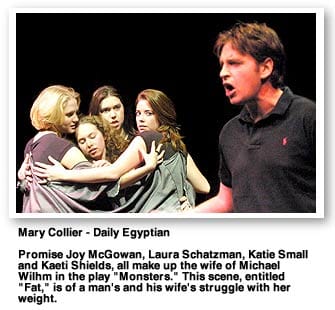
An assistant director told me that my one-act “Fat”, which focuses on fat fetishists, confused him: he didn’t know whether to “cum or vomit”.
A room full of Chicago directors argued over whether or not one of my one acts, "CNN" was brilliant or crap.
Planned Parenthood in Lubbock, Texas, asked me to write a one-act for one of their fundraisers; after seeing a final dress rehearsal, two days before production, they rescinded their invitation. They felt that the presence and staging of an abortion in “Little Miss Muffet” would offend their long-time donors.
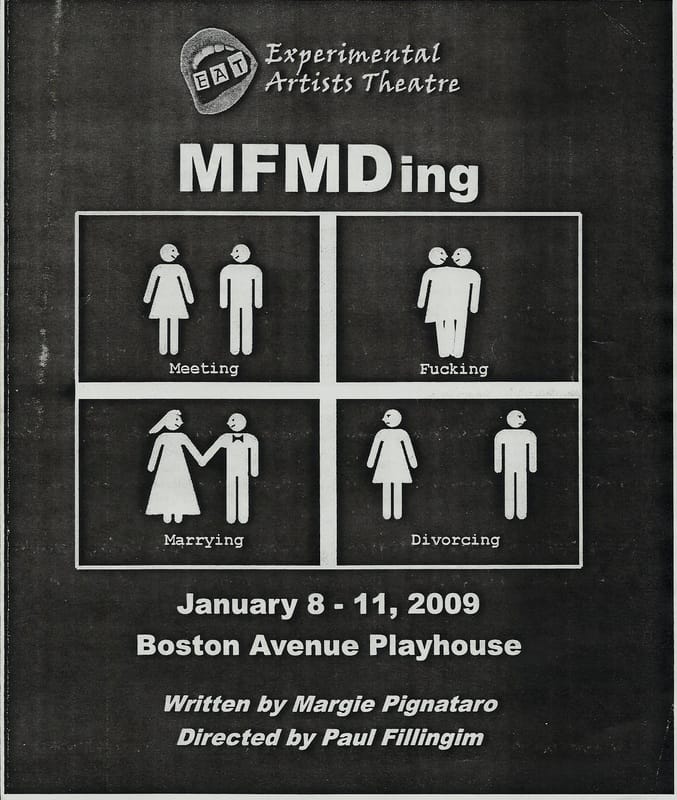
A Lubbock theater critic reviewed my play MFMDing on a local country music radio station and described it as "filthy material that was well-acted".
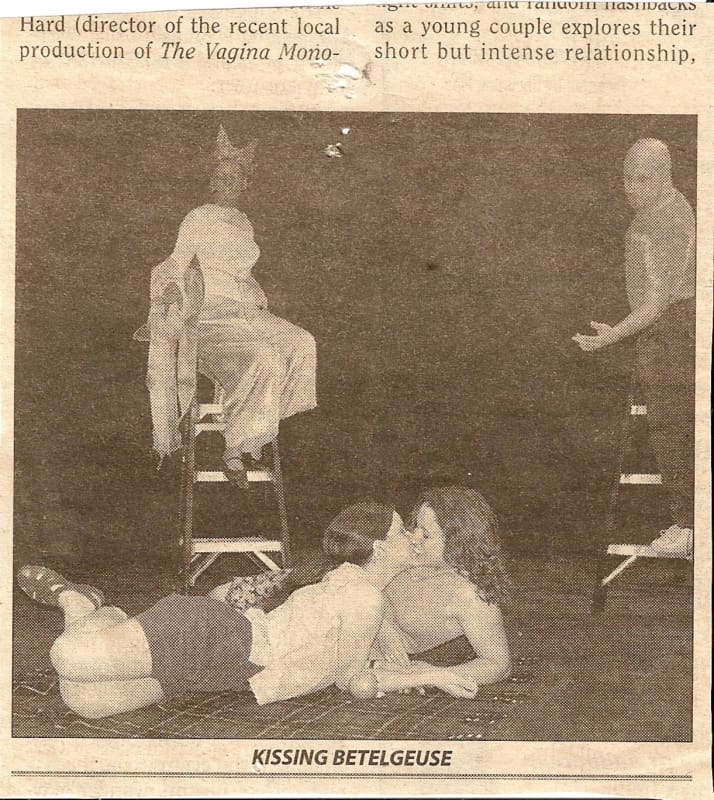
An audience member told me he hated my one-act, Kissing Betelgeuse; he thought the lesbianism was “unnecessary”.
A professor told me that some of the faculty in two different departments thought of me as “brilliant, difficult, or brilliant and difficult”.
I accept who I am, what I write, and my finicky attention span which demands I write things I haven’t seen before.
After all these years, I’ve finally realized that I’m not nontraditional enough. I need to stop holding back, hesitating because I fear more rejection. Now is the time in my life, when I can take any kind of insult or terrible review, when I must go nuts.
I have a draft of a sequel to MCST: Marie Curie Raises Atlantis (characters include Mark Twain, Nikola Tesla, Medusa and Dr. Frankenstein). I envisioned a third book, Marie Curie Conquers Mars. I thought I'd never work on them again. Now, I want to work on them again.